If planetary institutions govern the digital world, and the digital world increasingly structures the material conditions of the physical world, what is the politics of planetary democracy? Does that exist?
If contemporary citizenship builds on a history of political trauma - the trauma of past lives lost for the sake of political freedom - what kinds of citizens are we refusing to be, if we refuse to try to imagine another digital world order?
To refuse the work of imagination is to accept the world as given by those who are already building it. But imagination requires practice. It requires spaces to think differently, to experiment with alternative relations, to repair what has been damaged.
This is where the micro-politics of civic interplay begins: not in grand manifestos or total system redesigns, but in smaller acts of intentionally crafting different relations. In what data we choose to make visible or keep private. In what level of energy goes into algorithm training, versus local ecological repair. In which forms of intelligence—human, artificial, ecological—we invite into our decision-making processes, and on what terms.
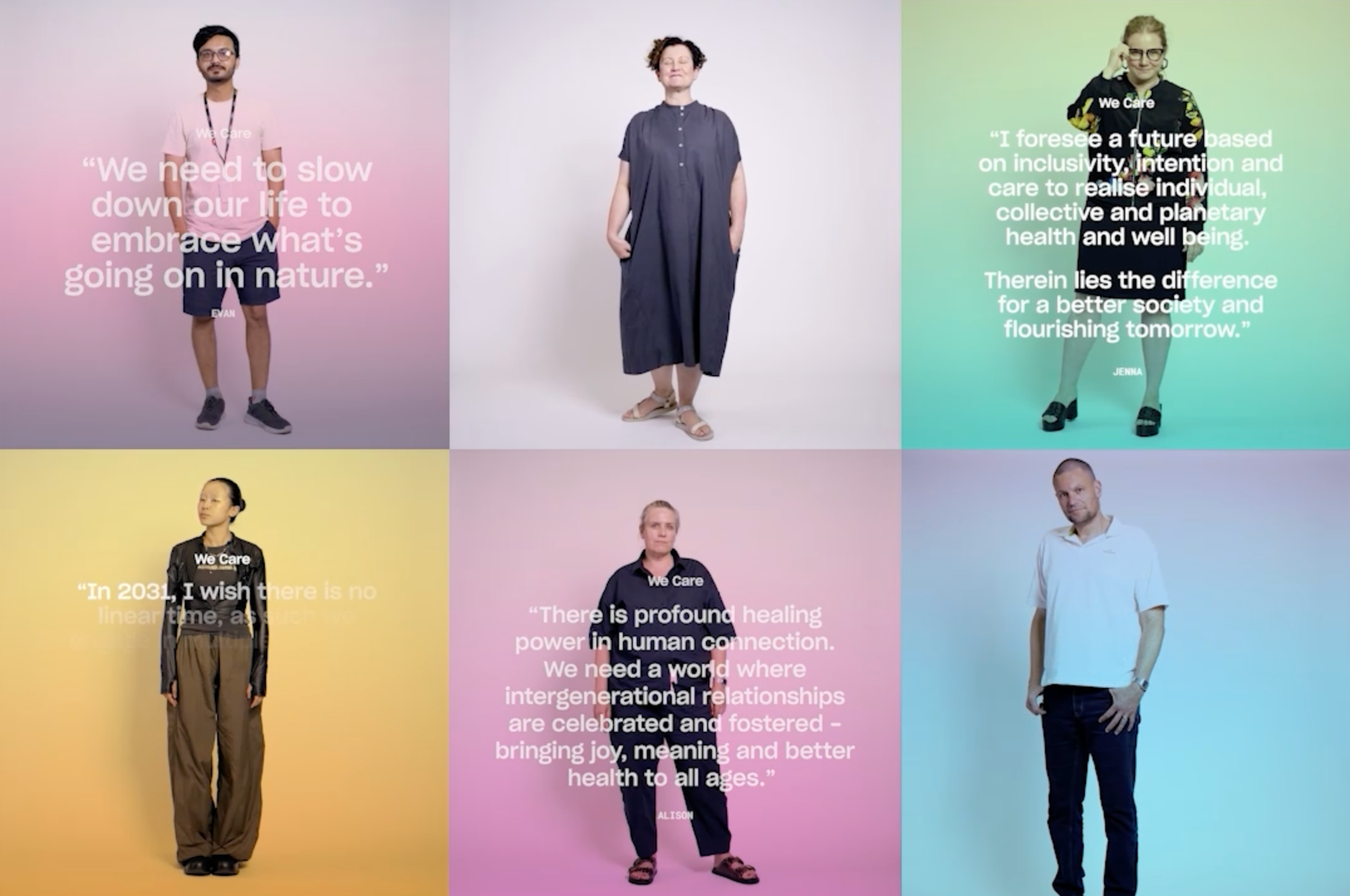
We Care: Defining a politics for learning habitats. RMIT City North Social Innovation Precinct, 2025. Creative Direction by Studio ESEM.
What counts as an act of politics, when digital scrolling places us in the crosshairs of a cybernetically-engineered system we didn’t realise we’d sworn allegiance to?
Seeking spaces of civil repair
The word civic is related to another word: civil. Both words relate to a Latin word, civis, or citizenship.
These words speak to how we relate to each other as citizens (being civil), and how we structure and govern these relations, through rights, duties and the functioning of public spaces (civics).
To be a civis, in the ancient sense, was to be a member of an ‘imagined community’ - in the specific sense, a citizen of Rome.
Our imagined communities today contain multitudes: of species, of co-intelligences.
How do we craft the workflows and digital relations that shape what kinds of ‘imagined community’ we belong to?
These are micro political acts; acts of civic interplay.
Civic Interplay sees micro-acts of political belonging being forged in the training grounds of co-intelligent habitats.